The Numbers Behind Landmark
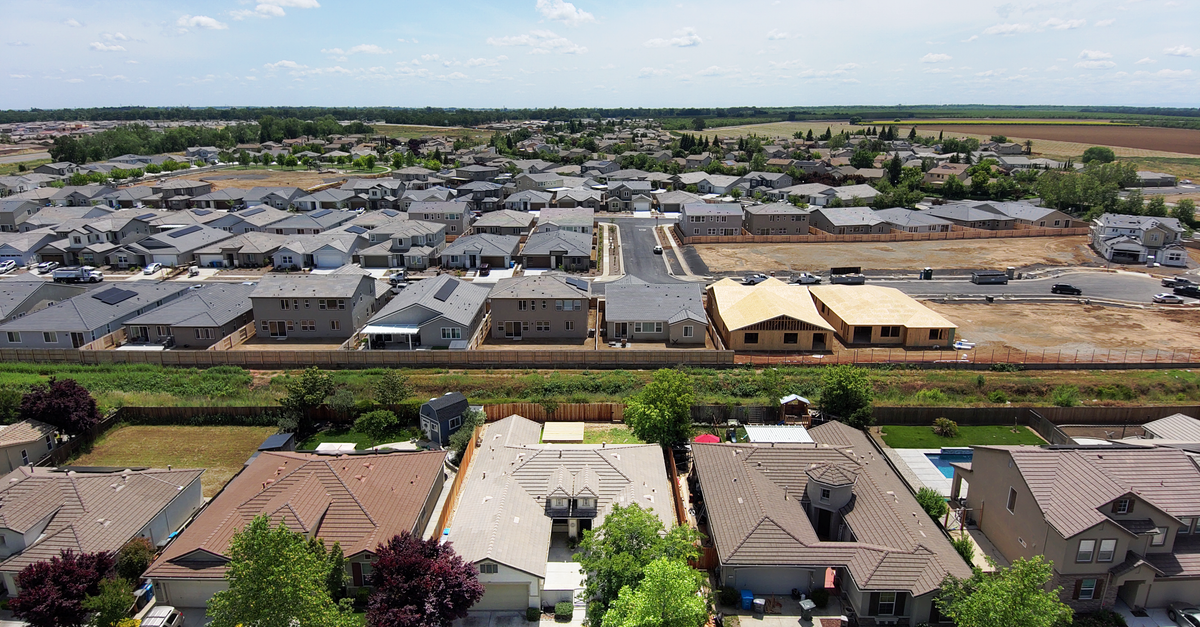
If you have driven I-35W recently near Robson Ranch Road, you have already seen the early signs of what may become the most consequential development project in Denton’s recent history. Hillwood, the Perot-family real estate firm, is building out a master-planned community called Landmark at that intersection — and the full build-out figures are the kind that tend to stop a conversation.
When complete, Landmark is projected to include 6,000 single-family homes, 3,000 apartment units, and 900 acres of commercial space. The population estimate attached to those numbers is more than 20,000 new residents — a figure that, on its own, would rank as a mid-sized Texas city. Model homes were slated to open in spring 2026, meaning the project has moved from planning documents and press releases into something Dentonites can actually walk through.
What Gets Built First, and Why It Matters
Among the commercial anchors planned for Landmark is Denton’s first H-E-B. For a city that has watched the beloved Texas grocery chain open locations in communities across the Metroplex while remaining conspicuously absent from Denton proper, that detail tends to generate more conversation than almost anything else in the project summary.
H-E-B has a particular loyalty among Texas shoppers that goes well beyond the typical grocery store relationship, and the prospect of one inside city limits — rather than a drive down the highway — is the kind of amenity that shifts where families choose to put down roots. Whether that store opens early in the development timeline or arrives later as the residential population fills in is still a matter of sequencing, but its inclusion in the plan at all signals that Hillwood is building toward a genuinely self-contained community, not simply another subdivision that relies entirely on existing Denton infrastructure.
Denton’s Context Makes This Different
It would be easy to hear “master-planned community” and picture the kind of satellite development that sits awkwardly at a city’s edge, connected to its host municipality mostly through annexation paperwork and tax rolls. Landmark’s scale pushes it into different territory. Adding north of 20,000 residents to Denton’s population is not a marginal change — it is the kind of growth that reshapes traffic patterns, school enrollment projections, park capacity, and the simple texture of daily life across the northwest quadrant of the city.
Denton has been navigating sustained population growth for years, and the city’s capital improvement machinery is already engaged on that front. Since 2005, Denton residents have committed $673.2 million in community investment through bond programs, and the city maintains a dedicated portal — Improving Denton — where anyone can track construction and improvement projects, check expected completion dates, and follow what the Capital Improvement Projects department has in the pipeline. That infrastructure context matters when thinking about Landmark, because a development that adds a small city’s worth of residents will intersect with that capital planning in ways that are just beginning to come into focus.
What a “Producer-Only” Standard Looks Like Next to This
There is something characteristically Denton about the fact that the same summer Hillwood is opening model homes for a 9,000-unit development, the Denton Community Market is running its weekly Saturday market at Denton County Historical Park under a producer-only standard — meaning the farms, artists, and food vendors at 317 W. Mulberry St. every Saturday from 9 a.m. to 1 p.m. are the people who actually made what they are selling. The market and the master-planned community are not in tension so much as they represent the two ends of the scale at which Denton operates simultaneously: a city that still cares about the provenance of a jar of honey and is also absorbing the infrastructure implications of a $10 billion development at its edge.
That dual reality is not unique to Denton, but Denton manages it with a particular self-awareness. The question Landmark raises is not whether growth is coming — that ship has sailed — but whether the growth takes on enough of Denton’s existing character to feel continuous with the city rather than appended to it.
The Practical Near-Term Picture
For residents tracking the project right now, the most concrete development is the model home openings that were scheduled for spring 2026. That phase converts Landmark from an announcement into something with a street address and a sales office, which tends to accelerate public engagement with the details. Hillwood’s project page offers the clearest running account of where things stand.
The I-35W and Robson Ranch Road corridor is worth watching through the rest of this year and into 2027. Whatever Denton looks like a decade from now, a significant portion of that picture is being framed at that intersection right now.