Why Does a National Touring Circuit Keep Stopping in Denton?
On Thursday, July 16, 2026, at 8:20 p.m., DCI Denton brings the Drum Corps International Texas Series to DATCU Stadium at 1251 S. Bonnie Brae St. For anyone unfamiliar with the activity, the arrival of a DCI tour stop in a mid-sized university city like Denton is worth examining on its own terms. It is not a coincidence, and it is not a small thing.
Drum Corps International is the governing body for elite, independent marching ensembles — corps — that recruit performers largely from the college-age population and compete at a level of technical and artistic precision that has little equivalent in the performing arts calendar. A summer DCI tour event is, in practice, a traveling showcase of perhaps the most demanding ensemble performance discipline in American music. Corps rehearse upward of twelve hours a day in the weeks before competition. The shows they perform are original productions, with custom arrangements, coordinated visual design, and choreography that involves the entire ensemble moving across a football field in formations that shift and evolve in real time.
The Texas Series designation matters for context. DCI organizes its summer schedule into regional clusters, and Texas events draw corps that are either headquartered in the region or routing through the Southwest as part of a longer national circuit. Denton’s placement on that map is not accidental.
What Makes DATCU Stadium a Workable Venue for This?
The logistics of hosting a DCI event are specific. Corps travel with semi-trucks carrying instruments, props, and equipment. The field itself must meet regulation dimensions. Sightlines from the stands have to accommodate an audience that is evaluating both the music and the visual design simultaneously — watching a corps from an end zone, for instance, collapses the spatial relationships that define the show’s geometry.
DATCU Stadium, home to the University of North Texas football program, addresses those requirements without the complications of a downtown or multipurpose venue. The stadium sits on Bonnie Brae Street on the western edge of UNT’s campus, which means its footprint includes the surrounding infrastructure — parking, access roads, support facilities — that a touring circuit needs to move equipment in and out efficiently between shows.
For Denton specifically, this also means the event draws into the established orbit of a campus community that already has an unusually high concentration of music students, faculty, and program alumni. UNT’s College of Music is one of the largest in the country, and it produces a significant number of the performers who eventually march with competitive corps. The audience for a DCI event in Denton is not being imported wholesale from elsewhere. A meaningful portion of it lives here.
What Is the Scale of What Audiences Are Actually Watching?
It is worth being precise about this, because the term “marching band” carries associations from Friday-night high school football that do not prepare most observers for what a top-tier DCI corps presents.
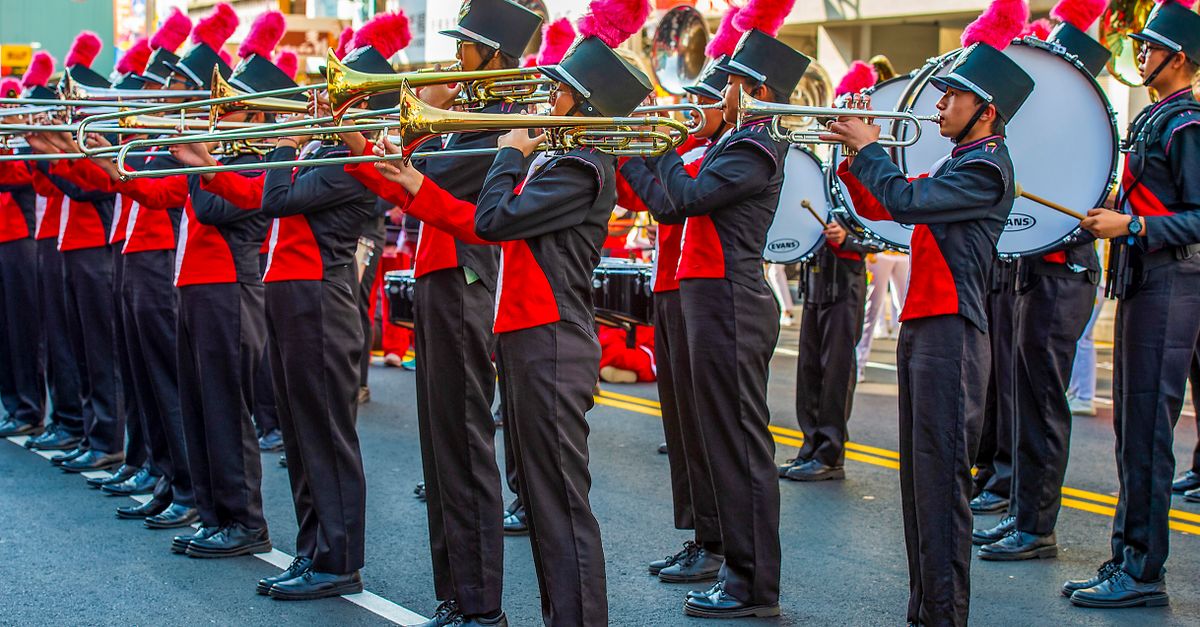
A competitive corps fields up to 150 performers, divided between brass, percussion, and color guard. The brass section produces volume levels that are genuinely startling in a stadium setting — not because the corps is playing loudly for its own sake, but because ensemble tuning and blend at that volume is part of what is being evaluated. The percussion section, which includes both the pit (front ensemble, positioned at the front sideline) and the battery (snare, tenor, and bass drums carried by marching performers), operates as an independent musical unit capable of carrying rhythmic complexity that the brass layer plays against and through.
The color guard — performers working with flags, rifles, and sabres, augmented increasingly by dance and acting — functions as the visual narrative layer of the production. In contemporary DCI design, guard members are often central to the theatrical concept of the show, not peripheral to it.
All of this happens simultaneously, in motion, on a field, across roughly eleven to twelve minutes per corps.
Who Brought This Event Together?
The July 16 Denton event is presented by Stanbury Uniforms, which serves as the presenting sponsor for DCI Denton. Stanbury’s involvement in DCI as a presenting partner reflects the tight commercial ecosystem that surrounds the activity — uniform manufacturers, instrument companies, and equipment suppliers are the natural corporate neighbors of a circuit built around ensemble performance at scale.
The sponsorship structure is worth noting from a community perspective because it is what makes tour stops in smaller markets financially viable. A city like Denton benefits from that model: the presenting sponsor absorbs a portion of the event cost that would otherwise require either higher ticket prices or a larger guaranteed audience than a single market night can reliably deliver.
What Does a Night Like This Mean for a City That Takes Music Seriously?
Denton has a well-documented relationship with live music, built over decades through the presence of UNT’s music programs, a dense ecosystem of local venues, and a general civic disposition toward the arts. The city’s music identity is usually discussed in terms of its bar and venue scene, or the academic output of the College of Music. DCI Denton sits outside both of those categories but connects to the same underlying infrastructure.
For the portion of Denton’s population with ties to the marching arts — former high school band members, current UNT music students, alumni of competitive winter programs that share personnel and design philosophy with drum corps — a summer DCI event is a reunion of a particular kind of fluency. These are audiences that understand what they are watching in technical terms, and that understanding changes the atmosphere inside the stadium.
For residents without that background, July 16 at DATCU offers something harder to categorize: a two-hour demonstration of what ensemble precision looks and sounds like at its outer edge, staged in a venue they probably associate with football Saturdays in the fall. The two experiences are genuinely different, and the contrast is part of what makes a DCI night in a university stadium feel specific to its place.
The show begins at 8:20 p.m. Denton’s summer evenings in mid-July hold heat well into the night, and DATCU’s open bowl amplifies that. Bring water, arrive with enough time to read the corps listings in the program, and find a seat in the upper rows if you want the full visual spread of the field. That is where the design makes the most sense.